Monday, October 31, 2011

Martin Luther was a Hero

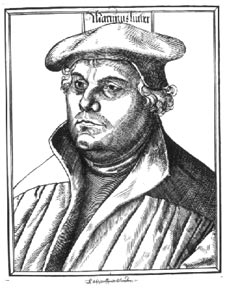
Exactly 494 years ago, on October 31, 1517, Martin Luther pinned his 95 Theses to the door to the church in Wittenburg, Germany. Little did he know, his declaration against the sale of indulgences would ignite a revolution that divided the Christian faith. Martin Luther was an Augustinian monk who, initially, was a devout Catholic. He whipped himself and slept in the snow in penance for his sins. In order to console the distraught Luther, he was made professor of theology at the University of Wittenburg. After reading the works of St. Peter, Luther came to realize that God was not vengeful and harsh but loving and forgiving. Meanwhile in Rome, Pope Leo X needed money to fund St. Peter's Basilica. He enlisted the help of Johan Tetzel to preach about purchasing indulgences, a document which granted forgiveness for all sins committed and those that will be committed and exemption from Purgatory. When his pupils began buying the indulgences, cried out against the corruption of the indulgences saying in Thesis 86: Why does not the pope, whose wealth is to-day greater than the riches of the richest, build just this one church of St. Peter with his own money, rather than with the money of poor believers? Luther acts of retaliation resulted in his excommunication and banishment, yet he was true hero for translating the Bible, retaliating against the corrupt Church, and allowing people to interpret the Bible their own way. 


Luther translated the Bible into German in 1522, enabling people the common people, who did not understand Latin, to read Scripture. This gave them a personal relationship with God, rather than relying on priests to tell them what the Bible says. The common people were empowered because the Church could no longer use people's ignorance of the Bible to their advantage. Luther's translation of the Bible into German vernacular was the not the first, but it was the most successful.  He studied the way Germans in the streets talked and used their words so that the Bible was comprehensible to commoners. Luther's Bible unified the German language.With the help of the printing press, Luther's Bible spread through out Germany. This influenced the the translation of the Bible into other vernaculars such as English, (The King James Bible of 1611) and even translations in Scandinavia and the Netherlands. 


Martin Luther's reforms allowed the people to have a personal relationship with religion. Today there are numerous branches of Christianity, from Methodist to Baptist to Coptic. Before Martin Luther, there was only Eastern Orthodox and Roman Catholic. He argued that there was no need for priests and sacraments, and that your own relationship with God would give you salvation. This expanded freedom of thought contributed to the scientific revolutions of the 17th and 18th centuries. 


Martin Luther fought against the sale of indulgences, simony, and the extravagance of the Roman Catholic Church.  The Church used indulgences, pieces of paper which forgave sins, as means to fund their own building projects and wealthy life style. Pope Leo X used the Church's money for his own purposes and then raised more money for St. Peter's Basilica with the common people's indulgences money. Simony was the sale of positions, rich people could buy positions in the clergy. Pope Leo X was not even a priest when he was elected, his father bought his cardinal-ship from the Pope. Martin Luther brought to light the Church abuses through his writing. During the Cathalic Reformation, the Roman Catholic Church retaliated against the Protestant Reformation by banning indulgences and simony. Not only did Luther establish a new religion, but he also reformed the Church. 

Wednesday, October 12, 2011

Martin Luther vs. Johan Tetzel

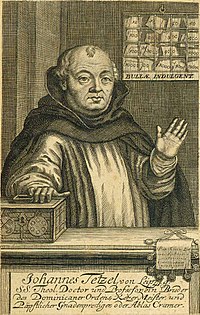
In 1517, a Dominican friar by the name Johann Tetzel was sent by Pope Leo X to preach about the sale of indulgences in order to raise money for Saint Peter's Basilica in Rome. This outrages Martin Luther, an Augustinian monk, who wrote the 95 Theses about why the sale of indulgences was corrupt and immoral. His writings was the spark that lit the bonfire of revolution across Europe. Not only did Luther and Tetzel differ on their views of the sale of indulgences but their ideas of God were very different.

Johann Tetzel, and Catholics at the time, saw God as being judgement and harsh. You are doomed no matter what you do because it is human nature to sin Tetzel warns by saying that "they are well-nigh numberless, and those that commit them must needs suffer endless punishment in the burning pains of Purgatory" (Tetzel, The Spark of Reformation: Indulgences).  He goes on by saying that  "for each and every mortal sin it is necessary to undergo seven years of penitence in this life or in Purgatory" (Tetzel, The Spark of Reformation: Indulgences).  In essence, Tetzel is preaching that sins are inevitable and God is going to punish you with 7 years in purgatory for each one. This paints a picture of God who is very judgmental and it inspires fear rather than love in the people. How could someone love a God who is going to punish them dearly for every sin they ever commit? By utilizing people's fear of Purgatory and their wish for salvation, the Church was able to manipulate the people into paying for indulgences that fund the Church's own extravagances.

Martin Luther and the Protestants viewed a loving God and that "to behold God in faith that you should look upon His fatherly, friendly heart, in which there is no anger nor ungraciousness" (Luther, Justification by Faith).  At first, Luther saw God as being "just and deals justly in punishing the unjust" (Luther, Justification by Faith). However, after reading Paul's Epistle to the Romans, he came to realize that God granted graciousness and mercy if you are simply faithful. He says that "faith leads you in and opens up God's heart and will, that you should see pure grace and overflowing love" (Luther, Justification by Faith).
Luther is saying that God will love you if you faithful that is the key to salvation, not committing "good acts" such as donating to the Church.

Sunday, October 2, 2011

"Blood Alone Moves the Wheels of History"

This quote, by the German monk and professor of theology, Martin Luther, states that to cause great reformation and change there must also be sacrifice and bloodshed. He was a religious reformer during the 16th century who split the Roman Catholic Church . Luther's religious reformation caused thousands to be killed during warfare or burnt at stake for their beliefs. What Luther means to imply is that great change will always have those opposed to it and we must fight for change for it to be successful. The term blood in his quote refers to the loss of human lives and warfare. One modern example of Luther's quote would be the Arab Spring this past summer and spring. Protesters were brutally killed by the police as they called for the end of government regimes. It started with a Tunisian man burning himself in protest of police corruption. This set off a wave of unrest across Algeria, Egypt, Jordan, and Yemen. One could argue that the violence was the sole successful method of overthrowing corrupt regimes.

Personally, I disagree with this quote. Yes, violence and wars are one way to ensure reform but they are not the only methods. There are plenty of examples of huge changes in history such as the industrial revolution and the digital revolution. No blood was shed over the invention of computers and the progress of the internet into a digital world. Wars have shaped history and made the world the way it is today. America is no longer a British colony because of the American Revolution in 1775. Yet one example of a bloodless revolution was the printing press which allowed books to be made quickly and cheaply, resulting in education and the spread of ideas. Books are still a huge part of our culture today. If I were to revise this quote I would say "Blood and Innovation Move the Wheels of History".