In the 1500s a fever swept across Europe, a fever of exploration which would forever alter the way Europeans thought, causing them to question their established ways. Explorers such as Columbus, Pizarro, and Magellan courageously faced the unknown, battling stormy seas, risking starvation, and pioneered the way for future world exploration. During the Middle Ages, people believed the Earth was much smaller than it actually was and only the few educated people knew that the Earth was round. There was no knowledge of the Americas or the civilizations which existed there. The majority of knowledge was based on Roman and Greek scientists and philosophers as well as the Bible. The discoveries of early explorers taught Europeans about the true size of the globe, world geography, and civilizations completely different from their own.
 On October 12, 1492 Christopher Columbus, an Italian explorer, landed on the east shore of modern day Florida. However, Columbus did know he had stumbled upon a new continent so he named it the West Indies and named the people "Indians". Columbus was being funded by King Ferdinand and Queen Isabella of Spain to find a route west to Asia. Columbus believed that because the Earth is round, he could continue sailing west from Europe and he would reach Asia eventually. Little did he know, the continents of South America and North America formed a virtually impenetrable barrier. Columbus returned with gold, lumber, cocoa, and cinnamon. He believed that he had found a route to Asia but later explorers figured out that he had in fact discovered two new continent. Columbus drastically changed the way Europeans saw the word because they believed that Africa, Europe, and Asia were the only continents. This increase people's knowlegde of the world and inspired future explorers such as Balboa, Cabot, and Cortes to explore the new land. They would bring back New World crops such as chili peppers, potatoes and corn as well as tales of the magnificant cultures

In 1536 Francisco Pizarro conquered the Incan empire, destroying their culture and enslaving the Inca people by forcing them to work in mines for the Spanish. In 1532 Pizarro arrived in the Inca city of Tumbez. The Incas were an advanced society with paved road systems, bridges, canals, gold work, and terrace farming. They did not view Pizarro and his horses and firearms as threat, yet Pizarro and his men killed the Inca ruler Atahualpa and sacked the major Inca cities. Pizarro changed the European view that the only advanced civilizations were in Europe and Asia. Europeans learned of cultures they had never come in contact with before.
Ferdinand de Magellan, a Portuguese explorer of noble birth, made the immensely difficult journey around South America in 1521. He was the first to sail west across the Pacific Ocean which he named after the Latin word for peaceful. Magellan wanted to sail under South America to Asia. However, he did not realize how gigantic the Pacific Ocean. It took Magellan ninety-eight days to cross the Pacific; the majority of his crew died from starvation or scurvy. On March 16, 1521 Magellan and the remainder of his crew reached the Philippines. Even though Magellan died in battle with the natives, his crew returned to Spain, becoming the first to circumnavigate the globe. Circumnavigation proved that the Earth was round, not flat (a misconception held by the uneducated in the 1500s). Magellan's voyage across the Pacific displayed how large the planet Earth is. aiding cartographers.


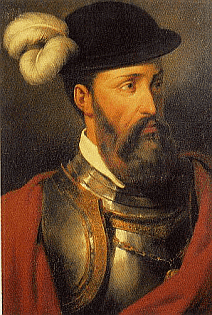
In 1536 Francisco Pizarro conquered the Incan empire, destroying their culture and enslaving the Inca people by forcing them to work in mines for the Spanish. In 1532 Pizarro arrived in the Inca city of Tumbez. The Incas were an advanced society with paved road systems, bridges, canals, gold work, and terrace farming. They did not view Pizarro and his horses and firearms as threat, yet Pizarro and his men killed the Inca ruler Atahualpa and sacked the major Inca cities. Pizarro changed the European view that the only advanced civilizations were in Europe and Asia. Europeans learned of cultures they had never come in contact with before.
Ferdinand de Magellan, a Portuguese explorer of noble birth, made the immensely difficult journey around South America in 1521. He was the first to sail west across the Pacific Ocean which he named after the Latin word for peaceful. Magellan wanted to sail under South America to Asia. However, he did not realize how gigantic the Pacific Ocean. It took Magellan ninety-eight days to cross the Pacific; the majority of his crew died from starvation or scurvy. On March 16, 1521 Magellan and the remainder of his crew reached the Philippines. Even though Magellan died in battle with the natives, his crew returned to Spain, becoming the first to circumnavigate the globe. Circumnavigation proved that the Earth was round, not flat (a misconception held by the uneducated in the 1500s). Magellan's voyage across the Pacific displayed how large the planet Earth is. aiding cartographers.


