Tuesday, December 6, 2011

Explorers Changing Established Ways

In the 1500s a fever swept across Europe, a fever of exploration which would forever alter the way Europeans thought, causing them to question their established ways. Explorers such as Columbus, Pizarro, and Magellan courageously faced the unknown, battling stormy seas, risking starvation, and pioneered the way for future world exploration. During the Middle Ages, people believed the Earth was much smaller than it actually was and only the few educated people knew that the Earth was round. There was no knowledge of the Americas or the civilizations which existed there. The majority of knowledge was based on Roman and Greek scientists and philosophers as well as the Bible.  The discoveries of early explorers taught Europeans about the true size of the globe, world geography, and civilizations completely different from their own.

On October 12, 1492 Christopher Columbus, an Italian explorer, landed on the east shore of modern day Florida. However, Columbus did know he had stumbled upon a new continent so he named it the West Indies and named the people "Indians". Columbus was being funded by King Ferdinand and Queen Isabella of Spain to find a route west to Asia. Columbus believed that because the Earth is round, he could continue sailing west from Europe and he would reach Asia eventually. Little did he know, the continents of South America and North America formed a virtually impenetrable barrier. Columbus returned with gold, lumber, cocoa, and cinnamon. He believed that he had found a route to Asia but later explorers figured out that he had in fact discovered two new continent. Columbus drastically changed the way Europeans saw the word because they believed that Africa, Europe, and Asia were the only continents. This increase people's  knowlegde of the world and inspired future explorers such as Balboa, Cabot, and Cortes to explore the new land. They would bring back New World crops such as chili peppers, potatoes and corn as well as tales of the magnificant cultures 

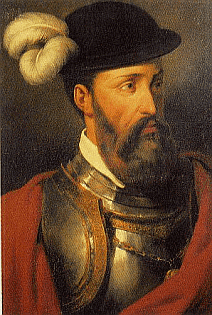
In 1536 Francisco Pizarro conquered the Incan empire, destroying their culture and enslaving the Inca people by forcing them to work in mines for the Spanish. In 1532 Pizarro arrived in the Inca city of Tumbez. The Incas were an advanced society with paved road systems, bridges, canals, gold work, and terrace farming. They did not view Pizarro and his horses and firearms as threat, yet Pizarro and his men killed the Inca ruler Atahualpa and sacked the major Inca cities. Pizarro changed the European view that the only advanced civilizations were in Europe and Asia. Europeans learned of cultures they had never come in contact with before. 


Ferdinand de Magellan, a Portuguese explorer of noble birth, made the immensely difficult journey around South America in 1521. He was the first to sail west across the Pacific Ocean which he named after the Latin word for peaceful. Magellan wanted to sail under South America to Asia. However, he did not realize how gigantic the Pacific Ocean. It took Magellan ninety-eight days to cross the Pacific; the majority of his crew died from starvation or scurvy. On March 16, 1521 Magellan and the remainder of his crew reached the Philippines. Even though Magellan died in battle with the natives, his crew returned to Spain, becoming the first to circumnavigate the globe. Circumnavigation proved that the Earth was round, not flat (a misconception held by the uneducated in the 1500s). Magellan's voyage across the Pacific displayed how large the planet Earth is. aiding cartographers.

Sunday, December 4, 2011

Top Five Motives of Exploration

What do you think were the top five motives for fifteenth and sixteenth-century Europeans went on voyages of exploration? Explain your answers. 


Trade- Before explorers discovered the New World, they were searching for a shorter route to Asia so that they could trade for spices. Spices were important in preserving food, adding flavor, perfume, and medicine. Prince Henry of Portugal spent many years redesigning ships, preparing maps, and training crew members so that eventually explorers could sail around Africa to Asia. His dream was realized in 1488 when Bartholomew sailed around the Cape of Good Hope. This enabled Vasco de Gama to make the same trip around Africa in 1497 to Calicut. In 1502 Vasco de Gamo made a treaty with the leader of Calicut and seized control of area around the Indian Ocean. A Portuguese trading empire developed. Another example of an explorer motivated by trade was Christopher Columbus who on August 3, 1492 sailed west from Spain to reach the East Indies. He had no idea that the Americas existed. Therefore, when he reached the Caribbean , he named the people he encountered, "Indians".
Conquest- Explorers such as Juan Rodrigez Cabrillo sailed to conquer new lands for their country. He sailed along the coast of modern day California, claiming land from San Diego to Oregon for Spain. Hernan Cortes, another Spanish explorers, overthrew the Aztec empire in 1519. Through conquest, explorers gained land for their country, prestige and awards, and riches. This motivated explorers to find new lands and conquer them.Countries such as Spain, France, Portugal, and England fought to gain territory and power. They endorsed explorers such as Pizarro and Cabot to claim lands, bring back riches, and enslave the native inhabitants. Pizarro, an Italian explorer, was successful in destroying the Inca empire. The gold from his expedition made Spain the richest country in Europe. The Inca people were forced to work in Spanish mines.


Christianity- Explorers spread the Christian faith through conversion of the native people. While Cabrillo did not personally convert the Native Americans of California, his discovery and exploration lead missionaries to later set up strict Christian missions. Magellan, whose sailors were the first to circumnavigate the world, baptized people of the Philippines by force and killed those who refused to become Christians. Today, the major religion of the Philippines is Catholicism. Another example of a European who spread the Christian faith is Francis Xavier. While he is not strictly an explorer, Xavier journeyed through India, Japan, and Indonesia where he set up convents and monasteries. In 1547-1529 Xavier converted 300,000 Japanese people to Christianity. However, the Japanese banned missionaries in 1550 along with the Jesuits so Xavier's efforts were fruitful in converting the Japanese.


Curiosity- It was one of the Renaissance ideals which lead explorers to discover new lands or routes. The Renaissance was a period of rebirth and return to classical ideals. Scholars around the world were studying the classics of Aristotle and Plato. People became more interested in secular subjects such as the humanities and human achievement. Meanwhile, the Scientific Revolution started in the 1500s; it was a shift in scientific thinking which stated that mathematical laws governed the universe. Both the Renaissance and Scientific Revolution were drastic changes which influenced the way people, such as explorers, saw the world around themselves. They inspired explorers to investigate the globe and broaden their horizons. Through the Renaissance, Scientific Revolution, and explorers the world became a much larger place, not limited by Medieval thinking.

Mapping-When explores began sailing the seas in late 1400s they quickly realized that their maps were inaccurate; maps did not even have the Americas. In 1499, Amerigo Vespuci discovered Brazil; later, a German cartographer read Vespuci's journals and named America after Vespuci. Using tools such as the astrolabe and portable compass, cartographers and explorers were able to more accurately describe the world.


Monday, November 28, 2011

Scientific Revolution Quotes

"Our scientific power has outrun our spiritual power. We have guided missiles and misguided men"
- Martin Luther King Jr.  

This quote was given by Martin Luther King Jr, a civil rights activist and clergyman during the 1960s in American. He spoke out against racial inequality, violence, and poverty through his many speeches and protests. What King wants to illustrate through this quote is that we must be moral and ethical and not get blinded by our scientific advancements. King was speaking out against the Vietnam war and the invention of missiles which had ability to kill thousands from a distance. Another example would be atomic bomb. On August 6, 1945, an atomic dropped over Hiroshima, Japan killed 90,000 to 160,000 people and wounded countless numbers of men, women, and children. Scientists worked for years to successfully create nuclear fission. However, they ended up creating a bomb which killed thousands. Martin Luther King Jr. is warning us not to advance with science and forget our morals. The scientific power he is speaking about is inventions and the spiritual power is not necessarily religious but also moral and ethical. When he says "we have misguided men" he is referring to the fact that we have become blinded by our achievements and we are forgetting human principles. 


I agree with Martin Luther King Jr.'s quote; I believe that before we advance in science we should always take into consideration the risks and long term affects. In a society where the latest, newest piece of technology is valued, we need to take a step back and examine the consequences objectively. 

Tuesday, November 15, 2011

Scientific Method


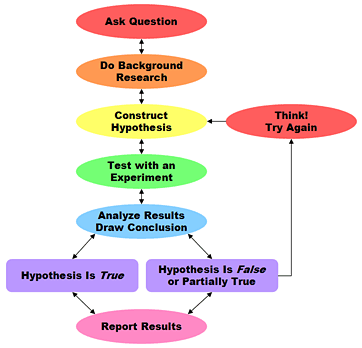
The scientific method is a process by which scientists try to determine a cause and effect relationship using experimentation. Scientists today continue to use the scientific method as a way to answer questions about the natural world. The scientific method is an organized, logical sequence of steps that enables scientists to validate or disprove their hypothesis by experimenting, collecting and analyzing data, and then drawing conclusions. Before beginning, scientists state the problem. Then they gather background information on the problem. After learning about what they will study, scientists make an educated guess about what the results will be, also called a hypothesis. During the experimentation step, scientists accurately record data and observations. Then they analyse and draw conclusions about the data. Was their hypothesis correct? Scientists often repeat their experiment by formulating better a  hypothesis of confirming their old one. The scientific method is still used today because it ensures accurate and unbiased tests which enable scientists to answer questions about the natural world or make new discoveries. 

Monday, October 31, 2011

Martin Luther was a Hero

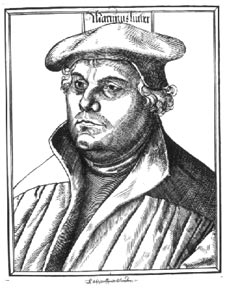
Exactly 494 years ago, on October 31, 1517, Martin Luther pinned his 95 Theses to the door to the church in Wittenburg, Germany. Little did he know, his declaration against the sale of indulgences would ignite a revolution that divided the Christian faith. Martin Luther was an Augustinian monk who, initially, was a devout Catholic. He whipped himself and slept in the snow in penance for his sins. In order to console the distraught Luther, he was made professor of theology at the University of Wittenburg. After reading the works of St. Peter, Luther came to realize that God was not vengeful and harsh but loving and forgiving. Meanwhile in Rome, Pope Leo X needed money to fund St. Peter's Basilica. He enlisted the help of Johan Tetzel to preach about purchasing indulgences, a document which granted forgiveness for all sins committed and those that will be committed and exemption from Purgatory. When his pupils began buying the indulgences, cried out against the corruption of the indulgences saying in Thesis 86: Why does not the pope, whose wealth is to-day greater than the riches of the richest, build just this one church of St. Peter with his own money, rather than with the money of poor believers? Luther acts of retaliation resulted in his excommunication and banishment, yet he was true hero for translating the Bible, retaliating against the corrupt Church, and allowing people to interpret the Bible their own way. 


Luther translated the Bible into German in 1522, enabling people the common people, who did not understand Latin, to read Scripture. This gave them a personal relationship with God, rather than relying on priests to tell them what the Bible says. The common people were empowered because the Church could no longer use people's ignorance of the Bible to their advantage. Luther's translation of the Bible into German vernacular was the not the first, but it was the most successful.  He studied the way Germans in the streets talked and used their words so that the Bible was comprehensible to commoners. Luther's Bible unified the German language.With the help of the printing press, Luther's Bible spread through out Germany. This influenced the the translation of the Bible into other vernaculars such as English, (The King James Bible of 1611) and even translations in Scandinavia and the Netherlands. 


Martin Luther's reforms allowed the people to have a personal relationship with religion. Today there are numerous branches of Christianity, from Methodist to Baptist to Coptic. Before Martin Luther, there was only Eastern Orthodox and Roman Catholic. He argued that there was no need for priests and sacraments, and that your own relationship with God would give you salvation. This expanded freedom of thought contributed to the scientific revolutions of the 17th and 18th centuries. 


Martin Luther fought against the sale of indulgences, simony, and the extravagance of the Roman Catholic Church.  The Church used indulgences, pieces of paper which forgave sins, as means to fund their own building projects and wealthy life style. Pope Leo X used the Church's money for his own purposes and then raised more money for St. Peter's Basilica with the common people's indulgences money. Simony was the sale of positions, rich people could buy positions in the clergy. Pope Leo X was not even a priest when he was elected, his father bought his cardinal-ship from the Pope. Martin Luther brought to light the Church abuses through his writing. During the Cathalic Reformation, the Roman Catholic Church retaliated against the Protestant Reformation by banning indulgences and simony. Not only did Luther establish a new religion, but he also reformed the Church. 

Wednesday, October 12, 2011

Martin Luther vs. Johan Tetzel

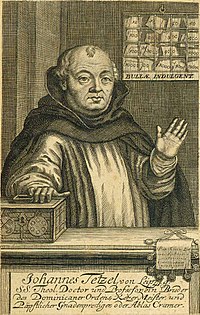
In 1517, a Dominican friar by the name Johann Tetzel was sent by Pope Leo X to preach about the sale of indulgences in order to raise money for Saint Peter's Basilica in Rome. This outrages Martin Luther, an Augustinian monk, who wrote the 95 Theses about why the sale of indulgences was corrupt and immoral. His writings was the spark that lit the bonfire of revolution across Europe. Not only did Luther and Tetzel differ on their views of the sale of indulgences but their ideas of God were very different.

Johann Tetzel, and Catholics at the time, saw God as being judgement and harsh. You are doomed no matter what you do because it is human nature to sin Tetzel warns by saying that "they are well-nigh numberless, and those that commit them must needs suffer endless punishment in the burning pains of Purgatory" (Tetzel, The Spark of Reformation: Indulgences).  He goes on by saying that  "for each and every mortal sin it is necessary to undergo seven years of penitence in this life or in Purgatory" (Tetzel, The Spark of Reformation: Indulgences).  In essence, Tetzel is preaching that sins are inevitable and God is going to punish you with 7 years in purgatory for each one. This paints a picture of God who is very judgmental and it inspires fear rather than love in the people. How could someone love a God who is going to punish them dearly for every sin they ever commit? By utilizing people's fear of Purgatory and their wish for salvation, the Church was able to manipulate the people into paying for indulgences that fund the Church's own extravagances.

Martin Luther and the Protestants viewed a loving God and that "to behold God in faith that you should look upon His fatherly, friendly heart, in which there is no anger nor ungraciousness" (Luther, Justification by Faith).  At first, Luther saw God as being "just and deals justly in punishing the unjust" (Luther, Justification by Faith). However, after reading Paul's Epistle to the Romans, he came to realize that God granted graciousness and mercy if you are simply faithful. He says that "faith leads you in and opens up God's heart and will, that you should see pure grace and overflowing love" (Luther, Justification by Faith).
Luther is saying that God will love you if you faithful that is the key to salvation, not committing "good acts" such as donating to the Church.

Sunday, October 2, 2011

"Blood Alone Moves the Wheels of History"

This quote, by the German monk and professor of theology, Martin Luther, states that to cause great reformation and change there must also be sacrifice and bloodshed. He was a religious reformer during the 16th century who split the Roman Catholic Church . Luther's religious reformation caused thousands to be killed during warfare or burnt at stake for their beliefs. What Luther means to imply is that great change will always have those opposed to it and we must fight for change for it to be successful. The term blood in his quote refers to the loss of human lives and warfare. One modern example of Luther's quote would be the Arab Spring this past summer and spring. Protesters were brutally killed by the police as they called for the end of government regimes. It started with a Tunisian man burning himself in protest of police corruption. This set off a wave of unrest across Algeria, Egypt, Jordan, and Yemen. One could argue that the violence was the sole successful method of overthrowing corrupt regimes.

Personally, I disagree with this quote. Yes, violence and wars are one way to ensure reform but they are not the only methods. There are plenty of examples of huge changes in history such as the industrial revolution and the digital revolution. No blood was shed over the invention of computers and the progress of the internet into a digital world. Wars have shaped history and made the world the way it is today. America is no longer a British colony because of the American Revolution in 1775. Yet one example of a bloodless revolution was the printing press which allowed books to be made quickly and cheaply, resulting in education and the spread of ideas. Books are still a huge part of our culture today. If I were to revise this quote I would say "Blood and Innovation Move the Wheels of History".